

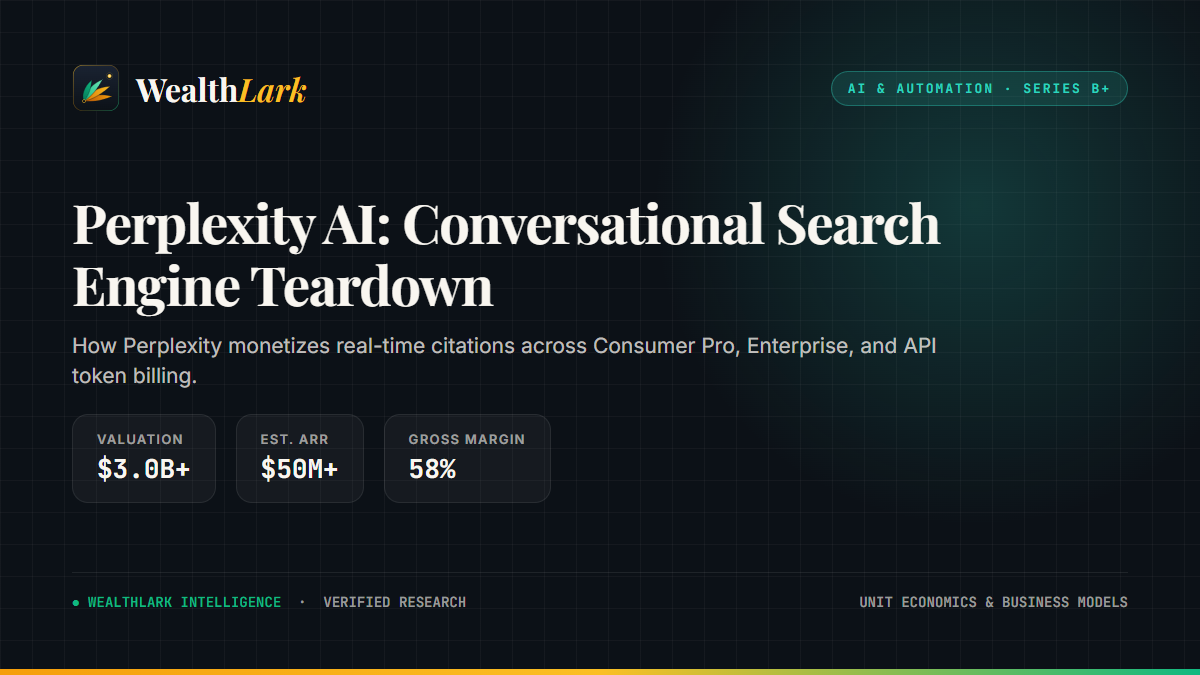
Executive Teardown Summary
Perplexity AI, founded in August 2022 by former OpenAI researcher Aravind Srinivas, Denis Yarats, Johnny Ho, and Andy Konwinski, re-invented consumer web search. While Google spent two decades optimizing a 10-blue-links page laden with sponsored advertisements and SEO-stuffed content farms, Perplexity built an answer engine: a conversational system that reads search results, verifies primary source documents, and produces an authoritative synthesized summary with inline interactive footnote citations.
Backed by Jeff Bezos, NVIDIA, and IVP at a valuation exceeding $3 billion, Perplexity surpassed $50 million in Annual Recurring Revenue (ARR) by expanding beyond its core consumer subscription into high-margin Enterprise Pro knowledge search and its developer-focused Sonar retrieval API.
1. The Core Problem and Market Gap
Traditional web search reached a point of severe informational degradation between 2020 and 2027.
The Breakdown of Legacy Web Search
- The SEO Spam Bog: Google search results became choked by affiliate marketing blogs, cookie-cutter AI content generated to capture ad impressions, and intrusive full-page popup banners.
- High Time-to-Answer Friction: Users seeking answers to complex questions (such as comparing medical clinical trials or parsing tax codes) had to click through 8 separate websites, scroll past endless introductory fluff, and manually piece together the facts.
- The Hallucination Trap of Raw Chatbots: First-generation ChatGPT queries lacked real-time web awareness, frequently hallucinating outdated product specs, inaccurate historical dates, or broken URLs.
Perplexity identified the critical breakthrough: Retrieval-Augmented Generation (RAG) paired with live web crawling. By forcing the model to cite exact sources for every declarative statement, Perplexity transformed LLMs from unreliable creative writers into trusted research engines.
2. How They Make Money (Unit Economics Breakdown)
Perplexity has successfully monetized three distinct customer tiers: individual power consumers, enterprise knowledge teams, and external software developers.
Revenue Streams
- Perplexity Pro ($20/mo or $200/yr): Unlocks 300+ daily Pro Searches using top-tier frontier models (Claude 3.5 Sonnet, GPT-4o), unlimited file uploads for document analysis, and generated image rendering.
- Enterprise Pro ($40/seat/mo): Adds SOC 2 Type II data privacy (zero customer data used for training), SSO integration, administrative team management, and internal company document search across Notion, Google Drive, and Slack.
- Sonar Search API ($5 per 1,000 Requests): Developers query Perplexity’s real-time search index and fine-tuned citation models to power external agent workflows.
Unit Economics Model (Estimated Per Active Pro User)
| Economic Metric | Early RAG Architecture (2023) | Perplexity Optimized Actuals (2027) |
|---|---|---|
| Monthly Subscription Price | $20.00 | $20.00 |
| Search Queries per Day (Average) | 18 Queries | 24 Queries |
| Frontier API Inference Cost | ($14.80) | ($6.90) (Fine-Tuned Small Routing) |
| Live Web Crawling and Indexing OpEx | ($2.10) | ($1.40) (Internal Scraping Cache) |
| Gross Profit per User / Month | $3.10 | $11.70 |
| Gross Margin (%) | 15.5% | 58.5% |
| Customer Acquisition Cost (CAC) | $45.00 | $14.20 (High Organic Word of Mouth) |
| User Retention (12-Month Cohort) | 52% | 68% |
3. Growth Drivers and Distribution Strategy
1. Carrier and Hardware Distribution Partnerships
Perplexity executed high-leverage distribution deals rather than relying solely on paid digital ads. Partnerships offering a free year of Perplexity Pro to Deutsche Telekom customers and Rabbit R1 buyers drove millions of new users into the product ecosystem.
2. “Pages” and Social Research Sharing
Users can convert any Perplexity search thread into a beautifully formatted, published article called a Perplexity Page. These pages rank organically on Google for niche long-tail search queries, turning the very search engine they aim to replace into their largest organic acquisition funnel.
3. The Enterprise Internal Knowledge Index
By allowing enterprises to search both the live public web and their internal corporate knowledge bases (Salesforce, Zendesk, internal wikis) in a single unified prompt, Perplexity moved from an executive luxury tool to an essential enterprise workflow utility.
4. 3 Actionable Lessons for Entrepreneurs and Investors
Lesson 1: Inline Citations Solve the Enterprise AI Trust Deficit
Consumers and corporate analysts will not act on AI-generated advice if they cannot verify where the data originated. Providing direct, clickable hyperlink citations transforms a generic AI answer into verifiable intelligence.
Lesson 2: Caching and Small Model Routing are Essential for RAG Margins
Querying frontier models for every single web search destroys unit economics. Perplexity routes routine factual queries to highly optimized, fine-tuned 7B/8B parameter models running on custom inference hardware, reserving expensive multi-step reasoning for deep research prompts.
Lesson 3: Use Incumbents’ Weaknesses Against Them
Google cannot easily replace its 10-blue-links search page with a single concise answer because doing so would cannibalize billions of dollars in pay-per-click (PPC) ad inventory. Perplexity leveraged this innovator’s dilemma to capture the most lucrative demographic: high-income knowledge workers.
Related Financial Terminals and Tools
- LQM vs LLM Financial Stress-Tester: Benchmark deterministic data retrieval vs probabilistic hallucination rates.
- AI CRM Outcome-Based Cost Terminal: Analyze API token consumption and per-seat SaaS software economics.
- Money Pulse Benchmark Rates Dashboard: Track official macroeconomic data and market spreads.