

Executive Teardown Summary
Clay, founded in 2017 by Kareem Amin and Nicolae Rusan, spent five years quietly iterating on a flexible relational table engine before exploding in 2023 and 2024 as the undisputed market leader in modern go-to-market (GTM) data orchestration. By turning a spreadsheet interface into an API router connecting over 100 third-party data providers (Apollo, Clearbit, Hunter, LinkedIn, GitHub, Crunchbase), Clay automated the manual prospecting workflows that previously required armies of Sales Development Representatives (SDRs).
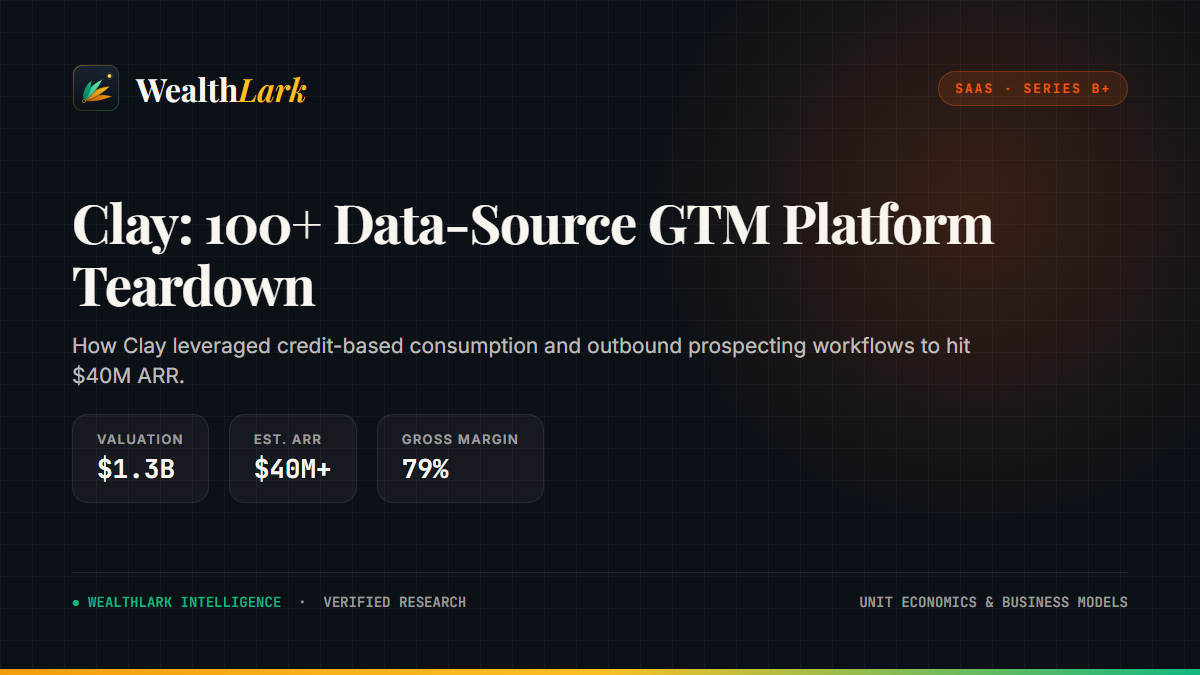
With a $1.3 billion valuation backed by Meritech and Sequoia, Clay scaled past $40 million in ARR while establishing a consumption-based credit flywheel that captures expansion revenue automatically as clients increase sales outbound volume.
1. The Core Problem and Market Gap
Modern enterprise B2B sales reached a breaking point as generic cold email spam filters tightened and response rates plummeted.
The Breakdown of Traditional Outbound Sales
- The Single-Vendor Data Trap: Relying on a single data provider (like ZoomInfo or Apollo) meant that 30% to 50% of phone numbers were invalid, emails bounced, or job titles were out of date. No single data provider has comprehensive data across all industries.
- The “Copy-Paste” SDR Grunt Work: SDR teams spent 70% of their workday opening 15 browser tabs per prospect: checking LinkedIn profiles, searching recent company blog posts, scraping job boards, and pasting snippets into CRM records.
- The Collapse of Mass Mail Merges: Blast email tools sending identical generic templates to 10,000 leads resulted in domain blacklisting and sub-0.5% reply rates.
Clay solved this by inventing Waterfall Data Enrichment: if Provider A does not have a verified work email, Clay automatically queries Provider B, then Provider C, ensuring a 90%+ data match rate before using an LLM to craft a hyper-personalized email referencing the prospect’s exact recent achievements.
2. How They Make Money (Unit Economics Breakdown)
Clay operates a hybrid monetization model combining a recurring SaaS software base fee with high-margin consumption-based credit packs.
Pricing Structure
- Starter Tier ($149/mo or $134/yr): 2,000 enrichment credits/mo. Suitable for solo founders and boutique agencies.
- Explorer Tier ($349/mo): 10,000 enrichment credits/mo, unlimited integrations, and webhooks.
- Pro Tier ($800/mo): 50,000 enrichment credits/mo, team collaboration seats, and advanced waterfall routing logic.
- Enterprise Custom ($2,000+/mo): Dedicated ClickHouse clusters, SOC 2 Type II compliance, custom API rate limits, and private LLM fine-tuning.
- Credit Overages ($0.02 to $0.05 per Credit): Instant credit purchases when high-velocity outbound campaigns exceed monthly subscription quotas.
Unit Economics Model (B2B SaaS Growth Client on Pro Tier)
| Financial Component | Legacy SDR Tech Stack | Clay Pro Workflow (2027) |
|---|---|---|
| Data Provider Subscriptions (ZoomInfo + Apollo) | $1,800 / Month | $0 (Included in Clay Credits) |
| Clay Platform and Credit Package | $0 | $800 / Month |
| Additional Enrichment Overages (25k Credits) | $0 | $500 / Month |
| Total Monthly GTM Software Cost | $1,800 / Month | $1,300 / Month (-28% Reduction) |
| Prospects Enriched and Contacted / Month | 3,500 Leads | 25,000 Leads (+614% Output) |
| Clay Gross Margin on Data Reselling (%) | — | 78.5% (High Margin Waterfall Resale) |
| Client Sales Meeting Booking Rate Lift | Baseline (1.1%) | 3.8% (3.4x Conversion Increase) |
3. Growth Drivers and Distribution Strategy
1. The “Claybook” Template Marketplace
Clay built a viral repository of community-created GTM workflows called Claybooks. A user can click a single template titled “Find all Y Combinator companies hiring React engineers and write a custom icebreaker based on their CEO’s latest tweet” and immediately duplicate the working pipeline into their account.
2. The GTM Agency Affiliate Flywheel
Rather than hiring massive internal implementation consulting teams, Clay certified hundreds of external growth marketing agencies as “Clay Experts.” These independent agency operators pitch their own B2B clients on Clay, generating over 45% of Clay’s qualified enterprise pipeline through decentralized partner referrals.
3. Native AI LLM Column Orchestration
In Clay, an AI prompt is simply a column in a spreadsheet. Adding a column that says “Look at the prospect’s company description in Column B and classify their pricing model into Freemium, Usage-Based, or Enterprise” executes across 10,000 rows in seconds, making AI deeply pragmatic for non-technical sales leaders.
4. 3 Actionable Lessons for Entrepreneurs and Investors
Lesson 1: Spreadsheets are the Universal Software Interface
Every business executive already knows how to navigate rows and columns. By packaging complex API integrations, data cleansing, and AI prompting into a familiar grid layout, Clay made advanced programmatic engineering accessible to non-technical sales teams.
Lesson 2: Waterfall Reselling Unlocks Massive SaaS Margins
By aggregating wholesale API demand from thousands of businesses, Clay negotiates steep volume discounts from data vendors (buying credits at $0.005 and reselling in bundles at $0.025 to $0.04), capturing software-like gross margins on third-party data.
Lesson 3: Empower an Ecosystem of External Champions
By creating a formal certification for independent freelance agency operators, Clay built an unpaid global army of evangelists who actively sell Clay licenses to their own enterprise consulting clients.
Related Financial Terminals and Tools
- Solo-Founder AI Margin Modeler (2027): Benchmark autonomous agency sales funnels and GTM overhead.
- AI vs Rep Payroll ROI Calculator: Compare SDR headcount compensation vs automated prospecting pipelines.
- AI CRM Outcome-Based Cost Terminal: Audit software licensing and consumption pricing ratchets.