
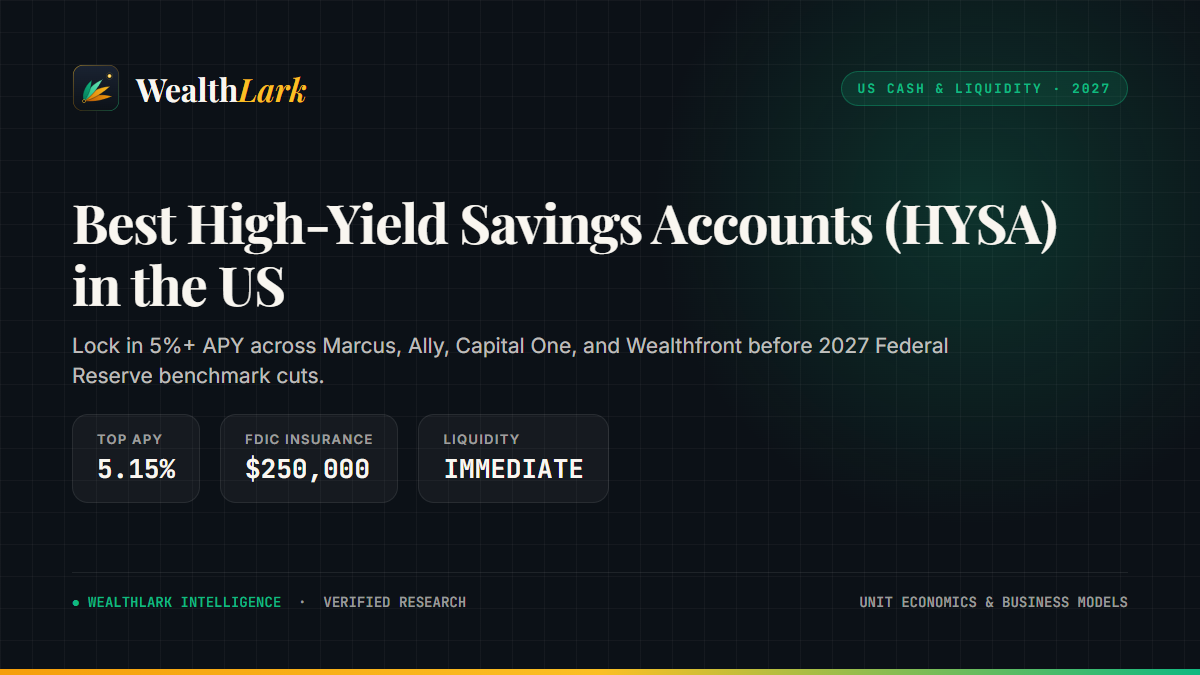
Best High-Yield Savings Accounts (HYSA) in the US (2027): Lock In 5%+ APY
Compare top FDIC-insured savings accounts from Marcus, Ally, Capital One, and Wealthfront. Calculate true annual yields before the Fed cuts rates in 2027.
Qasim Lak
Published
Written by Qasim Lak. Yield calculations benchmark official Federal Reserve Board H.15 releases and FDIC national rate caps.
On this page
If you keep your emergency cash or short-term house down payment reserves in a traditional brick-and-mortar checking or savings account at Chase, Bank of America, or Wells Fargo, you are effectively paying an invisible inflation tax. The national average savings account interest rate in the United States hovers at an abysmal 0.46% APY. On a $25,000 cash balance, that yields a pitiful $115 per year.
By contrast, the top FDIC-insured High-Yield Savings Accounts (HYSAs) and programmatic fintech cash sweep accounts currently pay 4.50% to 5.15% APY. On that same $25,000 emergency reserve, a top-tier account deposits over $1,280 in pure interest income directly into your account each year—with zero market risk, zero lock-up penalties, and full liquidity.
However, with the Federal Reserve engaged in an active monetary easing cycle heading into 2027, locking in high cash yields requires strategic planning. Here is an empirical, unvarnished comparison of the top US high-yield savings options for 2027.
2027 Top US High-Yield Savings Account Comparison
| Financial Institution | Current APY (2027) | Minimum Deposit | FDIC Coverage Type | Standout Feature |
|---|---|---|---|---|
| Wealthfront Cash Account | 5.00% APY | $1 | Up to $8M (Sweep Network) | Free same-day automated transfers to brokerage |
| Marcus by Goldman Sachs | 4.75% APY | $0 | $250k (Goldman Sachs Bank USA) | Same-day wire transfers with zero wire fees |
| Ally Bank Savings | 4.65% APY | $0 | $250k (Ally Bank Member FDIC) | Smart “Buckets” and recurring automated roundups |
| Capital One 360 Performance | 4.60% APY | $0 | $250k (Capital One, N.A.) | Physical branch and Capital One Cafe deposit access |
| SoFi Checking and Savings | 4.80% APY | $0 | Up to $2M with Direct Deposit | Highest APY when direct deposit is active |
1. How High-Yield Savings Accounts Actually Generate 5% Yield
Many consumers mistakenly believe that high yields are a “teaser scam” or carry hidden stock market exposure. The reality is grounded in straightforward commercial banking physics: Net Interest Margin (NIM).
Traditional banks maintain expensive overhead: thousands of physical retail branches, security guards, vault infrastructure, and local teller staff. To fund this real estate overhead, legacy banks pay depositors near-zero interest while lending customer money to credit card borrowers at 22% APR.
Online-only banks operate without physical real estate branches. Their customer service is digital, their infrastructure is cloud-native, and their operational costs are a fraction of traditional banks. They pass these operational savings directly back to depositors in the form of higher APY, while deploying reserve deposits into:
- Federal Reserve Overnight Repo Facilities: Earning risk-free interest pegged directly to the Effective Fed Funds Rate (EFFR).
- Short-Term US Treasury Bills (4-Week to 13-Week T-Bills): Backed by the full faith and credit of the United States Treasury.
- Ultra-Low-Risk Commercial Credit Lines: Yielding benchmark SOFR + 150 to 250 basis points.
2. Understanding APY vs. Nominal Interest: The Compounding Formula
Banks advertise Annual Percentage Yield (APY) rather than nominal interest rates because interest compounds continuously or daily.
The mathematical formula to determine your exact ending balance after one year of daily compounding is:
Ending Balance = Principal * (1 + (Annual Rate / 365))^365
Where:
- Ending Balance is the final value of your cash deposit after 365 days.
- Principal is your starting cash balance.
- Annual Rate is the bank’s quoted base nominal rate in decimal format.
The Real Cost of Procrastination (Worked 5-Year Example)
Suppose you maintain $40,000 in liquid cash reserves for five years:
- At Traditional Bank Rate (0.46% APY): You earn $928 total interest over 5 years.
- At High-Yield Savings Rate (4.85% APY): You earn $10,689 total interest over 5 years.
Leaving cash in a legacy checking account forfeits $9,761 in risk-free compounding cash—the equivalent of a free luxury vacation or an entire year of Roth IRA contributions.
3. Direct Bank vs. Fintech Sweep Network: What You Must Know
When evaluating accounts, you will encounter two structural models:
Model A: Chartered Direct Member Bank (Marcus, Ally, Capital One)
These institutions are chartered US commercial banks. Your money sits directly inside the bank’s own general ledger. FDIC insurance applies immediately up to the statutory limit of $250,000 per depositor, per account ownership category.
- Pros: Simple account structure; direct access to Federal Reserve Fedwire clearing rails; zero intermediary risk.
- Cons: Balances exceeding $250,000 are uninsured unless you open joint accounts or establish trust beneficiaries.
Model B: Programmatic Fintech Cash Sweep (Wealthfront, Betterment)
These platforms are registered broker-dealers or technology platforms, not banks. When you deposit $1,000,000 into Wealthfront, their automated algorithmic sweep program divides your cash into chunks of $245,000 and deposits them across up to 32 participating FDIC-insured partner banks (such as Citibank, HSBC, and Wells Fargo).
- Pros: Extends total FDIC insurance coverage up to $8,000,000 for individual accounts and $16,000,000 for joint accounts.
- Cons: In the event of a platform outage or partner bank reconciliation delay, accessing cash may experience a 24-to-48 hour settlement delay compared to a direct commercial bank wire.
4. How to Prepare Your Cash for 2027 Fed Rate Cuts
Because HYSA yields are variable, they do not stay fixed forever. When the Federal Open Market Committee (FOMC) votes to lower the target range for the Federal Funds rate, online banks lower their savings yields within days.
To defend your cash income against monetary easing cycles in 2027, employ a Tiered Cash Barbell Strategy:
Tier 1: Immediate Emergency Buffer (1 to 2 Months Expenses)
Keep this inside a top-tier liquid HYSA (such as Ally or Marcus). You maintain instant, same-day ACH liquidity to pay unexpected medical bills, car repairs, or plumbing emergencies without paying early withdrawal penalties.
Tier 2: Fixed-Rate Lock-in (3 to 6 Months Expenses)
Lock a portion of your cash into Fixed-Rate Certificates of Deposit (CDs) or short-term US Treasury Bills. Unlike a variable savings account, a 12-month or 18-month CD locks in your exact interest rate for the entire duration of the term, legally shielding your yield from any subsequent Federal Reserve rate cuts.
5. Federal and State Tax Obligations on HYSA Interest
Do not forget the tax man. The IRS treats high-yield savings interest as ordinary earned income, not long-term capital gains.
If you earn $2,500 in HYSA interest in 2027:
- If your marginal federal income tax bracket is 24%, you will owe $600 in federal tax.
- Depending on your state of residence (e.g., California at 9.3% or New York at 6.85%), you will also owe state income tax.
- If your income exceeds $200,000 (single) or $250,000 (married), you may also trigger the 3.8% Net Investment Income Tax (NIIT).
Pro Tip: For individuals in high-income-tax states (California, New York, New Jersey), buying US Treasury Bills (T-Bills) directly via TreasuryDirect or an ETF like SGOV yields comparable returns to an HYSA while being 100% exempt from state and local income taxes.
Interactive Financial Engines
- All WealthLark Financial Calculators: Model compound interest, mortgage amortization, and tax drag.
- US Personal Finance and Tax Hub: Live updates on Federal Reserve rate decisions, 401(k) limits, and IRS tax brackets.
- Money Pulse Benchmark Dashboard: Track real-time Effective Fed Funds, 10-Year Treasury Yields, and inflation metrics.
Qasim Lak
AuthorWritten by Qasim Lak. Yield calculations benchmark official Federal Reserve Board H.15 releases and FDIC national rate caps.
About Qasim & editorial process →