
What Fed Interest Rate Decisions Mean for US Mortgages in 2027
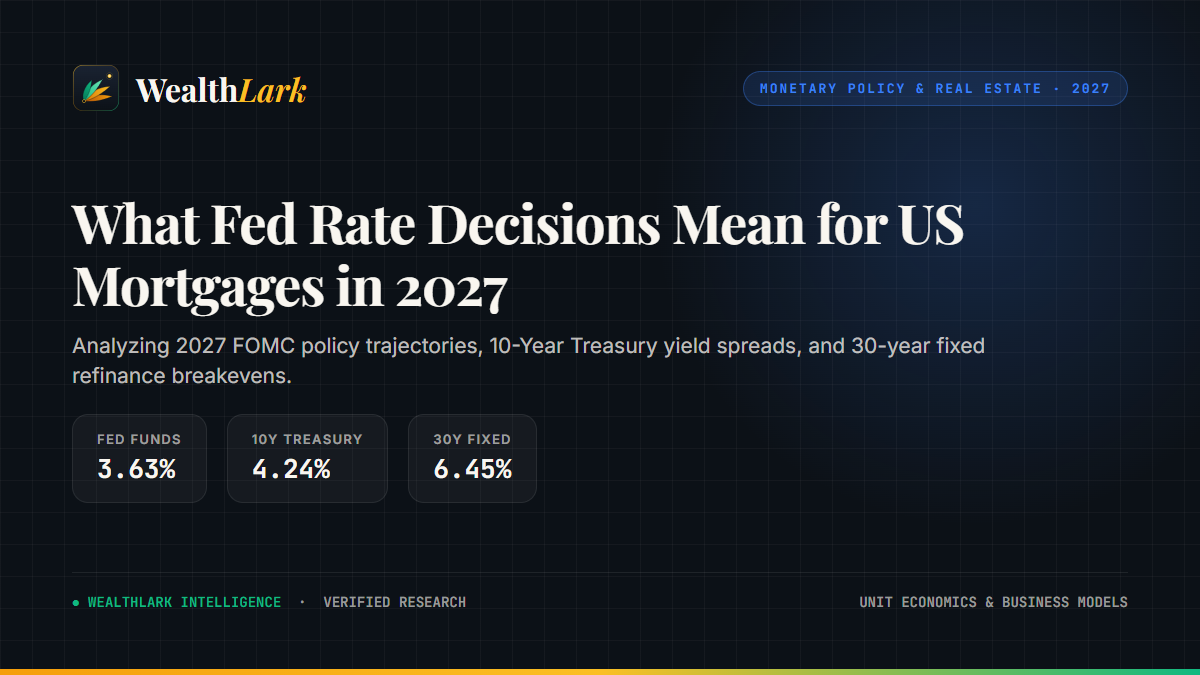
An analysis of 2027 FOMC rate trajectories, 10-Year Treasury yield spreads, and when homeowners should consider refinancing a 30-year fixed loan.
Qasim Lak
Published
Written by Qasim Lak. Monetary analysis references official Federal Open Market Committee (FOMC) statements, FRED St. Louis data series, and Freddie Mac PMMS surveys.
On this page
One of the most persistent misconceptions in personal finance is that when the Federal Reserve cuts interest rates by 25 or 50 basis points, 30-year mortgage rates immediately fall by the identical amount the next morning.
Homeowners who waited on the sidelines heading into 2027 were frequently baffled to watch the Federal Open Market Committee (FOMC) announce rate cuts, only to see 30-year fixed mortgage rates tick upward in subsequent weeks.
To understand where mortgage rates are heading in 2027 and calculate whether refinancing makes mathematical sense, you must understand the financial plumbing connecting Federal Reserve monetary policy, 10-Year Treasury bond yields, and Mortgage-Backed Security (MBS) credit spreads.
1. The Disconnected Link: Fed Funds vs. 10-Year Treasury Yields
The Federal Reserve directly controls only one interest rate: the Federal Funds Rate. This is the overnight lending rate that commercial depository banks charge each other to borrow excess reserves on an uncollateralized, overnight basis.
A 30-year mortgage, by contrast, is a long-term consumer debt instrument. While the average 30-year fixed mortgage is paid off or refinanced in 7 to 10 years, lenders fund these loans by packaging them into Mortgage-Backed Securities (MBS) that trade globally.
The primary financial anchor for 30-year residential mortgage rates is the 10-Year US Treasury Note Yield (FRED: DGS10), not the overnight Fed Funds rate:
30-Year Mortgage Rate ≈ 10-Year Treasury Yield + MBS Primary-Secondary Spread
Historical Basis Point Spreads
- Historical Normal Spread (1990 to 2020): 170 to 200 basis points (1.7% to 2.0%). If the 10-Year Treasury is at 4.00%, the 30-year mortgage trades around 5.80%.
- Elevated Spread Environment (2022 to 2027): 240 to 290 basis points (2.4% to 2.9%). When the Fed engages in Quantitative Tightening (shrinking its MBS balance sheet) and bond market volatility remains high, mortgage lenders demand a wider safety margin, keeping consumer borrowing rates elevated even when benchmark rates fall.
2. Why Mortgage Rates Move Before the Fed Meets
Bond markets are forward-looking discounting mechanisms. Long-term Treasury investors price in economic data (CPI inflation reports, non-farm payrolls, retail sales) weeks and months before the FOMC formally convenes in Washington.
If bond markets anticipate that the economy is cooling and that the Fed will cut rates three times heading into 2027, mortgage rates fall ahead of time. By the day the Fed chairman actually steps to the podium to announce the rate cut, the move is already 100% priced into Wall Street yields.
If the Fed chairman hints during the press conference that future cuts may be paused due to stubborn service-sector inflation, long-term bond yields spike, and mortgage rates jump higher the very afternoon a cut is enacted.
3. The Math of Mortgage Refinancing: The True Breakeven Formula
Do not refinance simply because an online lender tells you rates dropped by half a percent. Refinancing replaces your existing promissory note with a new loan, incurring closing costs that typically range from 2% to 4% of the total loan principal.
The Refinancing Breakeven Equation
Breakeven Horizon (Months) = Total Refinancing Closing Costs / Monthly Payment Savings
Worked Mathematical Audit ($450,000 Loan Balance)
Consider a homeowner who purchased a property with a 7.25% fixed 30-year mortgage, whose monthly principal and interest payment is $3,069:
| Scenario Comparison | Original 7.25% Loan | Refinance to 6.25% (-1.00%) | Refinance to 5.75% (-1.50%) |
|---|---|---|---|
| Loan Balance Refinanced | $450,000 | $450,000 | $450,000 |
| New Monthly Payment (P and I) | $3,069 | $2,771 | $2,626 |
| Monthly Cash Savings | $0 | $298 / Month | $443 / Month |
| Refinance Closing Costs (Est. 2.2%) | $0 | $9,900 | $9,900 |
| Breakeven Horizon | — | 33.2 Months (2.8 Years) | 22.3 Months (1.9 Years) |
| 5-Year Cumulative Net Savings | $0 | +$7,980 | +$16,680 |
Critical Strategic Rule: If you plan to sell the home, relocate for work, or upside-downsize in less than the calculated breakeven months, refinancing guarantees a net financial loss.
4. The Hidden Amortization Reset Penalty
There is a subtle trap in refinancing that loan officers rarely explain: resetting the amortization clock.
During the first 5 to 7 years of a 30-year mortgage, the vast majority of your monthly payment goes toward interest, with very little reducing the principal balance.
If you have already paid 5 years into a 30-year loan and refinance back into a brand-new 30-year term in 2027, you reset that clock back to Day 1. Even if your monthly payment drops by $200, you have extended your total indebtedness back out to 360 months, potentially paying tens of thousands more in total lifetime interest.
How to Avoid the Reset Trap:
- Refinance into a 20-Year or 15-Year Fixed Loan: This matches or accelerates your original payoff timeline while capturing lower interest rates.
- Keep Making Your Old Payment: If your new payment is $2,771 and your old payment was $3,069, continue paying $3,069 each month. The extra $298 goes 100% toward principal reduction, lopping 4 to 6 years off the end of your mortgage term.
5. Adjustable-Rate Mortgages (ARMs) vs. Fixed Loans in an Easing Cycle
In a high interest rate environment, lenders heavily market 5/1, 7/1, and 10/1 Adjustable-Rate Mortgages (ARMs), which offer lower introductory interest rates than fixed-rate products.
When an ARM Makes Financial Sense:
- You are 100% certain you will sell the property within the introductory fixed period (e.g., a corporate relocation in 4 years on a 7/1 ARM).
- The spread between the 30-year fixed and the initial ARM rate is wide (at least 100 to 150 basis points).
The Danger of ARMs:
If macroeconomic inflation flares up and the Federal Reserve is forced to reverse course and raise rates in future years, your ARM rate can adjust upward by up to 2.0% annually (subject to lifetime caps, often 5.0% above the initial rate). For long-term family residences, fixed-rate loans offer financial predictability that variable loans cannot match.
Related Financial Terminals and Hubs
- Money Pulse Benchmark Rates Dashboard: Live Fed Funds target range, Treasury yield spreads, and inflation indices.
- US Personal Finance and Tax Hub: Track federal interest rates, Treasury yield curves, and banking rules.
- All Free Financial Tools: Mortgage amortization calculators, debt payoff engines, and budgeting terminals.
Qasim Lak
AuthorWritten by Qasim Lak. Monetary analysis references official Federal Open Market Committee (FOMC) statements, FRED St. Louis data series, and Freddie Mac PMMS surveys.
About Qasim & editorial process →