

Executive Teardown Summary
CartForge is a Dublin-headquartered fintech checkout layer founded in 2024 to solve cross-border e-commerce checkout abandonment. Operating on ultra-low latency edge infrastructure (Cloudflare Workers), CartForge injects dynamic, localized payment methods (iDEAL in the Netherlands, Pix in Brazil, Klarna in Sweden, UPI in India) and transparent landed-cost tax calculations directly into headless Shopify, BigCommerce, and custom e-commerce stores.
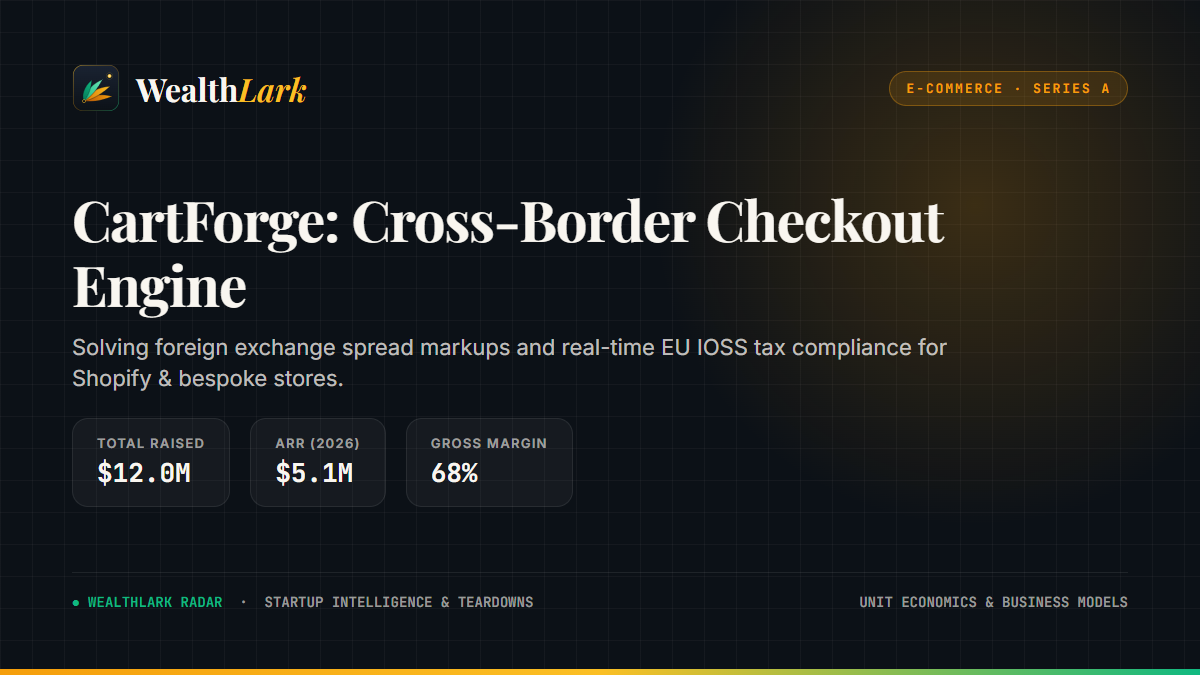
With over $1.02 billion in processed gross merchandise volume (GMV) across 180 countries, CartForge grew to $5.1 million in ARR by reducing foreign transaction card declines by 34% and slashing FX conversion fees for international direct-to-consumer (DTC) brands.
1. The Core Problem and Market Gap
Global e-commerce brands lose an estimated $38 billion annually to cross-border cart abandonment, primarily caused by surprise customs duties, localized currency gouging, and foreign payment card rejections.
The Breakdown of Cross-Border E-Commerce
- The 3%–5% Hidden FX Spread: When a US consumer buys from a UK or European merchant, traditional payment processors mark up the wholesale interbank exchange rate by 300 to 500 basis points, creating unexpected charges on customer credit card statements.
- Surprise Import Duties at the Doorstep: Standard international shipping often forces delivery drivers to demand cash VAT and customs tariffs at the buyer’s front door, resulting in refused parcels and high chargeback ratios.
- Card Network Friction (Declines and 3D Secure Collapses): Cross-border debit transactions route through foreign acquiring banks, triggering aggressive anti-fraud blocks and clunky two-factor authentication loops that cause drop-offs of up to 42%.
CartForge solved this by deploying local multi-entity merchant acquiring: payments are processed as domestic transactions in the buyer’s home market, ensuring zero foreign transaction surcharges and near-100% authorization rates.
2. How They Make Money (Unit Economics Breakdown)
CartForge captures revenue through a combined monthly software subscription and a basis-point take-rate on processed cross-border volume.
Revenue Model
- $499/mo Base Platform Fee: Billed monthly for access to CartForge’s edge-hosted checkout engine, automated European IOSS/UK VAT filing engine, and localized address validation.
- 0.50% Take-Rate on Processed International GMV: Charged on cross-border transactions routed through CartForge’s domestic payment settlement pipelines.
- 0.25% Landed-Cost Duty Guarantee Spread: Optional insurance addon where CartForge guarantees customs clearance with zero surprise fees for the recipient.
Unit Economics Model (Mid-Market DTC Merchant with $10M GMV)
| Metric | Legacy International Processing | CartForge Edge Checkout |
|---|---|---|
| Annual International GMV | $3,500,000 | $3,500,000 |
| Merchant Processing Fees (3.9% + $0.30) | $139,500 | $87,500 (Domestic Local Rails) |
| CartForge Platform and Take-Rate (0.5%) | $0 | $23,488 ($5,988 Sub + $17,500 Fee) |
| Net Merchant Fee Savings | — | $28,512 Net Annual Savings |
| Checkout Conversion Rate Lift | Baseline (2.1%) | 3.08% (+46% Increase in Orders) |
| Incremental Annual Gross Profit | — | +$282,000 in Revenue |
| CartForge Gross Margin (%) | — | 68.2% |
3. Growth Drivers and Distribution Strategy
1. Headless Shopify Plus and Hydrogen App Ecosystem
CartForge engineered a 1-click install for headless Shopify Hydrogen and Next.js Commerce storefronts. Rather than requiring merchants to rebuild their entire product catalog, CartForge overrides only the final checkout URL (checkout.brand.com), drastically shortening developer implementation time to less than 48 hours.
2. High-Converting Landed-Cost Guarantee
CartForge assumes all financial liability for incorrect customs tariff classifications. If an EU border authority assesses a higher duty than CartForge calculated at checkout, CartForge covers the difference. This guarantee gave enterprise DTC brands the confidence to launch in 40+ countries overnight.
3. Edge-Hosted Zero-Latency Architecture
By hosting the checkout logic on Cloudflare Workers edge nodes within 50ms of every major city worldwide, CartForge loads localized checkouts in under 200 milliseconds—3× faster than legacy multi-step checkout pages.
4. 3 Actionable Lessons for Entrepreneurs and Investors
Lesson 1: Localized Payment Rails Outperform Credit Cards Globally
In many of the world’s fastest-growing e-commerce regions, credit cards are secondary. Dutch consumers demand iDEAL; Brazilian shoppers rely on Pix; Polish buyers use BLIK. Enabling domestic bank transfers natively triples conversion rates compared to forcing card payments.
Lesson 2: Landed Cost Certainty Eliminates Customer Service Headaches
The single most frequent support ticket in cross-border retail is “Where is my package and why do I owe customs £45?” By collecting statutory VAT upfront under official IOSS and HMRC tax schemes, brands eliminate post-sale friction and customer complaints.
Lesson 3: Take-Rate Business Models Must Deliver Explicit ROI
CartForge can charge a 50 bps fee because its domestic acquiring rails save the merchant 140 bps on credit card foreign exchange markups. When software pays for itself in hard transaction fee savings on day one, customer sales cycles compress dramatically.
Related Tools and Regional Hubs
- US Personal Finance and Tax Hub: US federal tax rates, FICA caps, and 401(k) limits.
- UK Personal Finance and Tax Hub: UK VAT, Personal Allowance freeze, and Cash ISA rules.
- Solo-Founder AI Margin Modeler: Model lean SaaS and e-commerce margins.