

Executive Teardown Summary
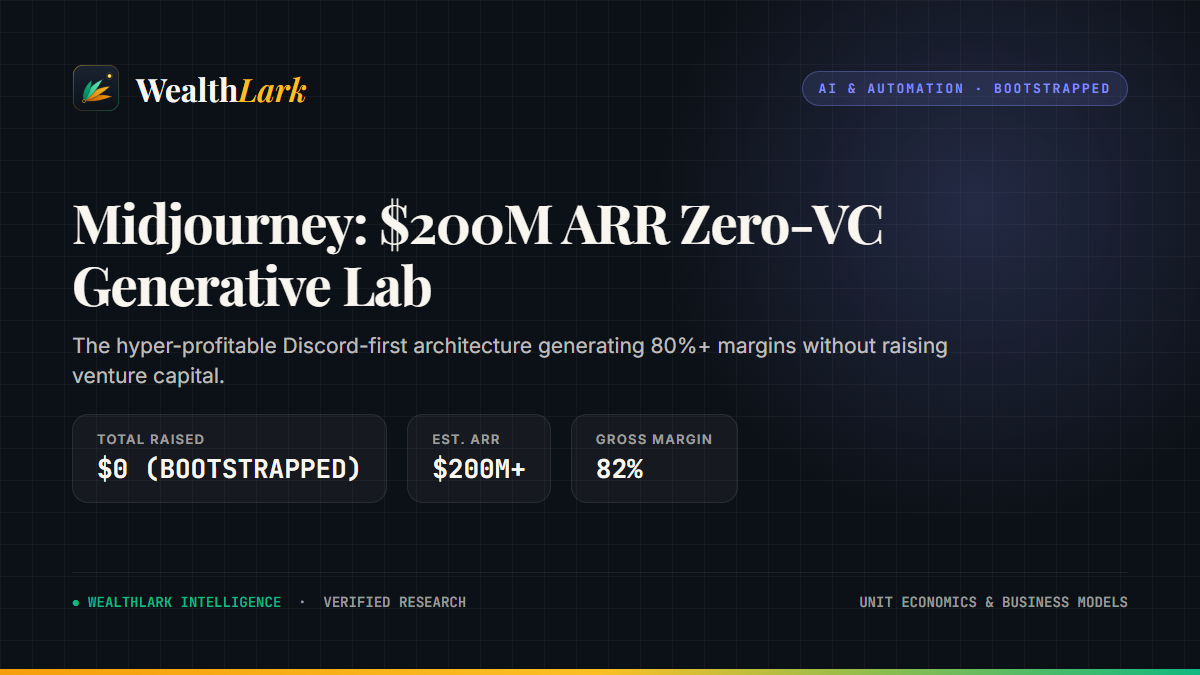
Midjourney represents the most commercially efficient technology company of the generative AI revolution. Founded in early 2022 by Leap Motion co-founder David Holz, the self-funded research lab reached over $200 million in Annual Recurring Revenue (ARR) with zero venture capital, zero traditional marketing spend, and a core team of fewer than 20 full-time employees.
By choosing to run its entire user interface inside Discord rather than building an expensive web and mobile client application, Midjourney bypassed millions in front-end development overhead and tapped into a ready-made social community of 20+ million digital artists, designers, game developers, and marketing agencies.
1. The Core Problem and Market Gap
When diffusion-based image generation models (like early DALL-E and Stable Diffusion) emerged, they were inaccessible to non-technical creative professionals.
The Breakdown of Early Generative Image Tools
- The Terminal and Python Barrier: Running early open-source models required high-end Nvidia RTX desktop GPUs, CUDA dependency debugging, and running command-line scripts locally.
- Clinical and Soulless Outputs: Competing corporate models prioritized hyper-realistic stock photo generation, resulting in sterile, plasticky images that lacked artistic composition, lighting nuance, and cinematic texture.
- The High Cost of Web Infrastructure: Building interactive canvas tools, authentication systems, cloud storage CDN layers, and mobile apps requires dozens of specialized engineers before generating a single dollar of revenue.
Midjourney recognized that creative professionals cared about artistic aesthetics, not photorealistic stock photography. By tuning its diffusion weights for Painterly lighting and cinematic composition, Midjourney created images that looked like fine art straight out of the box.
2. How They Make Money (Unit Economics Breakdown)
Midjourney monetizes through recurring monthly consumer and commercial subscriptions, with zero free ad-supported tiers.
Subscription Tiers
- Basic Plan ($10/mo or $96/yr): 3.3 hours of Fast GPU time per month (roughly 200 image generations).
- Standard Plan ($30/mo or $288/yr): 15 hours of Fast GPU time plus unlimited “Relaxed” generation hours (queued during idle GPU cycles).
- Pro Plan ($60/mo or $576/yr): 30 hours of Fast GPU time, stealth image generation (hiding prompts from public community channels), and 12 concurrent fast jobs.
- Mega Plan ($120/mo or $1,152/yr): 60 hours of Fast GPU time and dedicated enterprise concurrency.
- GPU Top-Ups ($4 per Fast Hour): Instant credit-card purchases for power users who exhaust their monthly fast generation quota.
Unit Economics Model (Estimated Per Average Subscriber Across Blended Tiers)
| Cost / Revenue Component | Traditional VC AI App | Midjourney Bootstrapped Actuals |
|---|---|---|
| Blended Monthly ARPU | $14.50 | $32.50 (High Pro and Mega Mix) |
| Cloud Compute (Google Cloud TPU v4 Clusters) | ($8.20) | ($5.40) (Batch Queue Optimization) |
| Hosting, Discord Webhook, and Storage OpEx | ($1.80) | ($0.40) (Discord Absorbs CDN / Hosting) |
| Payment Processing (Stripe 2.9% + $0.30) | ($0.75) | ($1.15) |
| Net Gross Profit per User / Month | $3.75 | $25.55 |
| Gross Margin (%) | 25.8% | 78.6% to 82.4% |
| Headcount per $1M ARR | 12 Employees | 0.08 Employees (Unprecedented Leverage) |
| Customer Acquisition Cost (CAC) | $35.00 | $0.00 (Pure Discord Viral Expansion) |
3. Growth Drivers and Distribution Strategy
1. The Built-In Discord Social Feed
By default, all Midjourney image generations and prompt prompts occur in public Discord rooms. When a user generates an incredible fantasy landscape, hundreds of other users in the channel see the prompt, react with emojis, and copy the prompt parameters to iterate on it. This turned image generation into an addictive, communal multiplayer game.
2. “Stealth Mode” as a Paid Premium Upsell
In most B2C apps, privacy is free while features cost money. Midjourney inverted this dynamic: using the tool publicly is affordable ($10 to $30), but if a corporate brand or game studio wants to hide their prompts and outputs from competitors, they must pay $60 to $120 per month. This single monetization lever converted thousands of commercial studios into high-tier subscribers.
3. TPU Capacity Contracting and Queue Arbitrage
Midjourney negotiated massive reserved multi-year capacity agreements with Google Cloud for specialized TPU v4 pods. By offering “Relaxed” mode generation that runs only when TPUs are idle, Midjourney achieves nearly 100% compute hardware utilization around the clock.
4. 3 Actionable Lessons for Entrepreneurs and Investors
Lesson 1: Build Inside Existing Social Graph Ecosystems
You do not need a custom website or mobile app to build a $100M+ software business. By launching inside Discord, Midjourney inherited instant user authentication, real-time WebSockets, social notifications, community moderation, and mobile responsiveness for zero engineering cost.
Lesson 2: Aesthetic Taste is a Defensible Moat
Algorithms and diffusion math are largely open-source research papers. What cannot be easily copied is human editorial taste: the subtle weighting of color palettes, volumetric lighting, and camera depth of field that makes an image feel emotionally resonant.
Lesson 3: Freedom from Dilution Enables Long-Term Focus
Because David Holz took zero VC money, Midjourney never faced pressure to rush out low-margin enterprise consulting deals, hire bloated executive management layers, or pivot to unproven advertising models. They remain laser-focused on core research and product excellence.
Related Financial Terminals and Tools
- Solo-Founder AI Margin Modeler (2027): Benchmark autonomous digital businesses and high gross margin architectures.
- AI vs Rep Payroll ROI Calculator: Calculate output leverage and labor replacement multiples.
- SaaS Shadow-Tax Audit Teardown: Analysis of AI inference infrastructure expenses.