

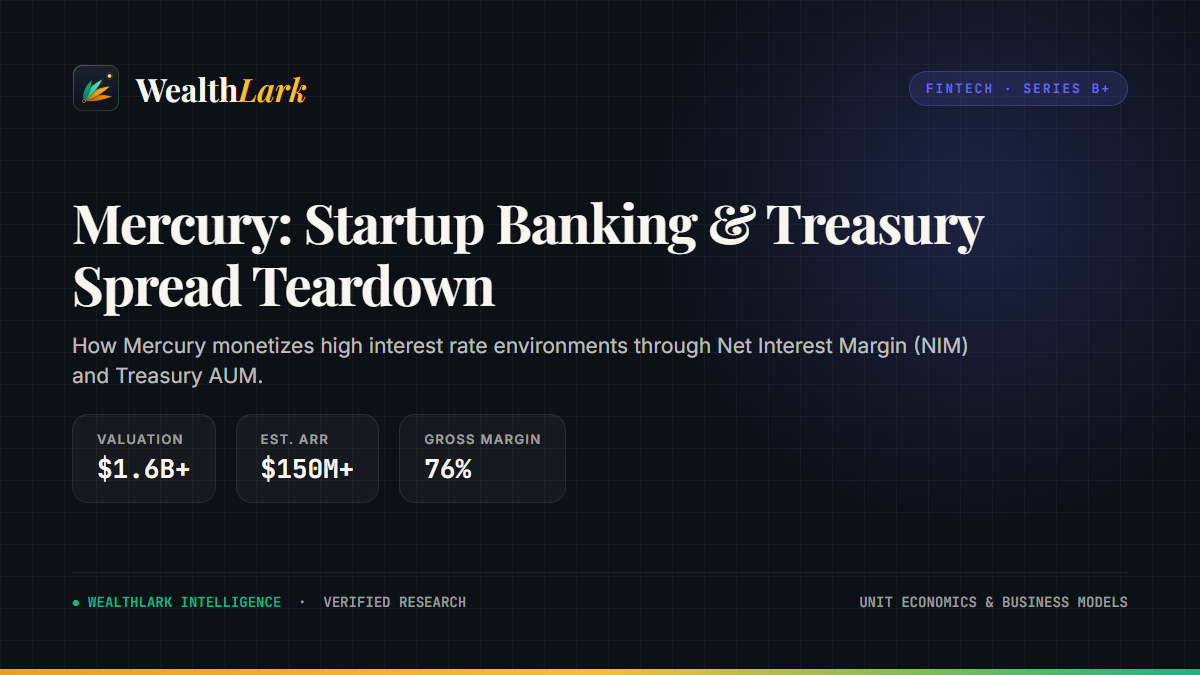
Executive Teardown Summary
Mercury, founded in 2017 by serial entrepreneur Immad Akhund (co-founder of Heyzap), reimagined commercial banking for technology founders. While traditional commercial institutions like Wells Fargo and Silicon Valley Bank subjected early-stage tech founders to physical branch visits, notarized paper faxes, and clunky 1990s web portals, Mercury built a consumer-grade financial operating system written in Haskell.
Following the dramatic collapse of Silicon Valley Bank in March 2023, Mercury became the primary beneficiary of enterprise tech flight-to-safety, absorbing billions in new startup deposits. Reaching over $150 million in annualized revenue, Mercury demonstrated how modern software interfaces can capture immense financial margins on banking spreads.
1. The Core Problem and Market Gap
Traditional commercial banking treats startups with deep suspicion and bureaucratic indifference.
The Breakdown of Legacy Commercial Banking
- The In-Person Branch Barrier: Incorporating a US Delaware C-Corp as an international or remote founder was easy; opening an operational US commercial bank account often required flying to New York or San Francisco to present a physical passport at a branch counter.
- Abysmal Software Interfaces: Traditional corporate banking portals required clumsy physical RSA hardware tokens, lacked programmatic developer APIs, and took 3 to 5 business days to clear simple wire transfers.
- The Uninsured Deposit Cliff: Standard FDIC insurance only protects up to $250,000 per depositor per bank. A startup that raised a $10 million Series A was forced to manually distribute cash across dozens of separate banking entities or risk catastrophic loss during a bank insolvency.
Mercury saw that founders wanted an API-driven financial control terminal, not a physical bank branch with teller counters.
2. How They Make Money (Unit Economics Breakdown)
Mercury is a financial technology company (partnered with FDIC-insured member banks like Choice Financial Group and Evolve Bank and Trust). Because Mercury does not have the balance sheet overhead of a physical bank, its software-driven unit economics are extraordinary.
Revenue Streams
- Net Interest Margin (NIM) on Uninvested Deposits: Mercury and its partner banks earn yield by sweeping cash into Federal Reserve overnight repo facilities and short-term US Treasuries, retaining a spread of 120 to 180 basis points on idle checking deposits.
- Mercury Treasury Management Fee (15 to 20 bps AUM): Startups with $500,000+ in deposits can automatically allocate excess cash into automated Morgan Stanley government money market funds yielding ~5% APY. Mercury captures a 0.15% to 0.20% annual asset management fee.
- Card Interchange (Visa Network 1.5% to 2.1%): Captured whenever employees spend on Mercury corporate debit and credit cards.
- Cross-Border FX Spreads (1.0% Wire Conversion Fee): Billed when founders convert foreign currencies into USD or send international wire payouts.
Unit Economics Model (Client Account with $2.5M Average Deposit Balance)
| Revenue Stream | Basis / Volume | Mercury Annual Gross Revenue |
|---|---|---|
| $500k Operating Checking (NIM Yield Spread @ 1.5%) | $500,000 Balance | $7,500 / Year |
| $2.0M Mercury Treasury AUM (18 bps Management Fee) | $2,000,000 Balance | $3,600 / Year |
| Corporate Debit and Credit Spend (1.7% Net Interchange) | $250,000 Annual Spend | $4,250 / Year |
| International Inbound/Outbound Wires (FX Spreads) | $120,000 Volume | $1,200 / Year |
| Total Annual Revenue per High-Growth Client | — | $16,550 / Year |
| Partner Bank Revenue Share and Regulatory OpEx | — | ($3,950) |
| Mercury Net Gross Profit per Client | — | $12,600 / Year |
| Gross Margin (%) | — | 76.1% |
3. Growth Drivers and Distribution Strategy
1. The Startup Accelerator and Legal Formation Funnel
Mercury partnered directly with incorporation platforms (Stripe Atlas, Clerky, Firstbase) and top accelerators (Y Combinator, Techstars). The exact moment a founder files their Delaware incorporation paperwork, they are offered 1-click Mercury account opening, capturing high-potential startups before legacy banks even know they exist.
2. Mercury Vault: Up to $5M in Automated FDIC Insurance
In the immediate aftermath of SVB’s bank run, Mercury deployed Mercury Vault: a programmatic sweep network that automatically distributes customer cash across up to 20 partner banks, providing up to $5 million in aggregate FDIC insurance coverage with zero manual paperwork. This feature catalyzed over $2 billion in deposit inflows in under two weeks.
3. Developer-First APIs and Clean Haskell Backend
Mercury built a first-class REST API that allows engineering teams to programmatically pay vendors, trigger contractor stipends, and pull real-time general ledger transactions directly into internal databases.
4. 3 Actionable Lessons for Entrepreneurs and Investors
Lesson 1: Build for the World as It Is, Not as It Was
Legacy banks assumed founders worked in downtown offices and wanted to meet relationship managers for steak dinners. Mercury recognized that modern founders are remote, globally distributed, code in TypeScript, and value instant digital wire execution above all else.
Lesson 2: Macro Interest Rate Hikes Supercharge Fintech Float
When benchmark interest rates rose from 0% to over 5%, traditional SaaS companies suffered valuation compression. Mercury, by contrast, saw its Net Interest Margin expand exponentially, turning idle deposit balances into a massive cash cow.
Lesson 3: Consumer-Grade Design is Rare and Defensible in B2B Finance
Finance software is historically clunky and frustrating. Investing in bespoke typographic design, keyboard shortcuts, fast search, and delightful UX transforms a commodity utility (a checking account) into a beloved cult product.
Related Financial Terminals and Tools
- Money Pulse Benchmark Rates Dashboard: Live Fed Funds target range, Treasury yields, and SOFR spreads.
- US Personal Finance and Tax Hub: Track federal interest rates, Treasury yield curves, and banking rules.
- AI CRM Outcome-Based Cost Terminal: Audit software spend and corporate overhead.