

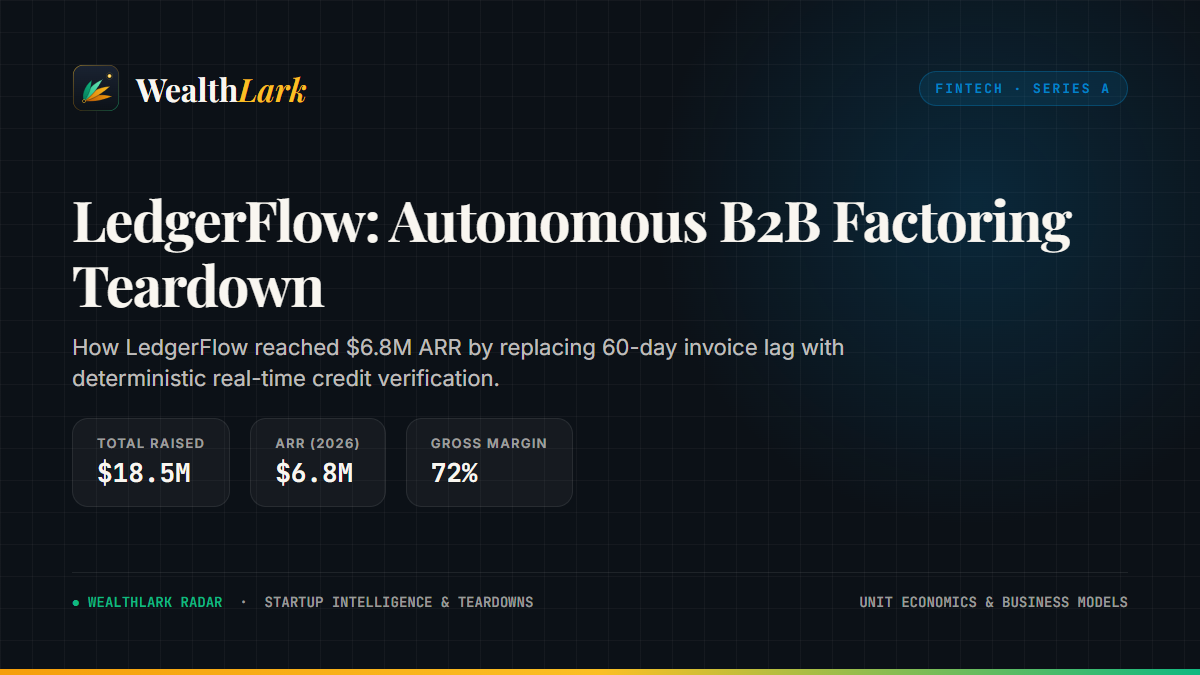
Executive Teardown Summary
LedgerFlow addresses one of the most stubborn friction points in mid-market corporate finance: the 45-to-75 day Days Sales Outstanding (DSO) lag between invoice generation and cash settlement. Founded in San Francisco in 2024, the company integrates directly into enterprise resource planning (ERP) platforms (NetSuite, SAP S/4HANA, QuickBooks Enterprise) and deploys deterministic quantitative models to audit buyer solvency, verify delivery milestones, and fund verified invoices within 90 seconds.
By combining low-cost algorithmic underwriting with instant ACH and FedNow clearing rails, LedgerFlow has originated over $310 million in B2B invoices across manufacturing, chemical logistics, and IT staffing sectors while maintaining a sub-0.08% cumulative default rate.
1. The Core Problem and Market Gap
Mid-market B2B suppliers ($10M to $150M annual revenues) operate under immense working capital constraints. While Fortune 500 enterprise buyers routinely mandate Net-60 or Net-90 payment terms, suppliers must meet payroll, purchase raw inventories, and fund operations weekly.
The Failure of Legacy Financing Options
- Traditional Bank Lines of Credit: Slow application cycles (8–12 weeks), restrictive blanket personal guarantees, and rigid borrowing base certificates that penalize rapid quarterly revenue expansion.
- Legacy Invoice Factoring Houses: Punitive factoring fees ranging from 2.5% to 4.5% per 30 days, aggressive recourse collection tactics that alienate client accounts, and opaque shadow fees (wire fees, minimum volume penalties, processing charges).
- Neo-Lending Marketplaces: Surface-level balance sheet checks that rely on simple bank scrapers, resulting in high rejection rates or punitive risk surcharges during macro credit contractions.
LedgerFlow identified the fundamental market gap: Accounting verification, not buyer refusal, is the true cause of payment delay. More than 73% of overdue B2B invoices stem from matching discrepancies between Purchase Orders (POs), Bills of Lading (BOLs), and invoice line-item tax calculations—not liquidity insolvency.
2. How They Make Money (Unit Economics Breakdown)
LedgerFlow operates a hybrid revenue model combining high-margin recurring SaaS software retainers with capital-efficient transactional financing spreads.
Revenue Streams
- 0.85% Transaction Spread (Net-30 Origination): On funded invoices, LedgerFlow charges a baseline discount fee of 0.85% per 30 days of advance capital. For a $100,000 invoice settled in 32 days, LedgerFlow captures $906.67 in gross spread revenue.
- $1,200/mo ERP Integration and Audit Retainer: Billed annually ($14,400/year per client) for real-time bi-directional two-way synchronization between the client’s ERP and buyer procurement portals.
- 0.15% Collections Clearing Fee: Charged on non-factored invoices routed through LedgerFlow’s automated collection reconciliation pipeline.
Unit Economics Model (Per Active Client Account)
| Metric | Target Benchmark | Actual LedgerFlow 2027 Performance |
|---|---|---|
| Average Monthly Origination Volume | $450,000 | $612,000 |
| Gross Spread Captured (0.85%) | $3,825 | $5,202 |
| Monthly SaaS Software Retainer | $1,200 | $1,200 |
| Cost of Capital (Benchmark SOFR + 1.85%) | ($2,100) | ($2,815) |
| Net Gross Profit per Client / Month | $2,925 | $3,587 |
| Gross Margin (%) | 65% | 72.1% |
| Customer Acquisition Cost (CAC) | $14,000 | $11,850 |
| CAC Payback Period | 6.5 Months | 3.3 Months |
| Net Revenue Retention (NRR) | 115% | 138% |
3. Growth Drivers and Distribution Strategy
Rather than relying on generic cold outbound email campaigns, LedgerFlow executed a programmatic two-sided distribution playbook:
1. The “Supplier Trojan Horse” Distribution Loop
When an enrolled supplier initiates collection through LedgerFlow, their enterprise buyers receive dynamic remittance notices with deep-link portals showing exact PO line items, delivery receipts, and electronic remittance options (FedNow, RTP, ACH).
Over 22% of enterprise buyers whose suppliers utilized LedgerFlow subsequently requested the platform for their own downstream vendor disbursement workflows, creating an organic B2B viral coefficient ($K = 0.31$).
2. Native Accounting System App Marketplace Distribution
LedgerFlow built certified first-party connectors for Oracle NetSuite, Microsoft Dynamics 365 Business Central, and Sage Intacct. Being featured as a “Preferred Financial Infrastructure App” in NetSuite’s SuiteApp catalog drove 44% of qualified inbound demo requests heading into 2027.
3. Syndicated Warehouse Debt Facilities
Rather than carrying originated invoices directly on its venture balance sheet, LedgerFlow secured a $150M revolving asset-backed credit facility from Silicon Valley credit funds at SOFR + 185 bps. By offloading balance sheet credit risk to institutional capital partners, LedgerFlow operates as an asset-light software originator.
4. 3 Actionable Lessons for Entrepreneurs and Investors
Lesson 1: Build the Software Utility Before Selling the Financial Product
Suppliers did not adopt LedgerFlow because they wanted another factoring lender; they adopted it because its automated PO-to-invoice reconciliation solved their internal finance team’s manual data entry nightmare. Once the software had deep visibility into verified enterprise ledgers, underwriting risk became trivial.
Lesson 2: Two-Way ERP Synchronization Creates Insurmountable Moats
Once an enterprise integrates a platform into their chart of accounts, automated general ledger reconciliation, and treasury payout rails, churn falls to near zero. LedgerFlow reports an annual gross churn rate of sub-1.8%, making their customer lifetime value (LTV) exceed $140,000 against a $11,850 CAC.
Lesson 3: Deterministic Financial Solvers Beat Probabilistic LLMs
LedgerFlow specifically discarded general-purpose generative AI for invoice underwriting, opting for deterministic state machines and quantitative tabular models. In financial accounting where a single misplaced decimal point creates millions in liability, deterministic verification is non-negotiable.
Related Financial Terminals and Modeling Tools
- Solo-Founder AI Margin Modeler (2027): Model software-enabled service margins and autonomous cash flow.
- LQM vs LLM Financial Stress-Tester: Audit deterministic financial math vs LLM hallucination risks.
- AI CRM Outcome-Based Cost Terminal: Audit software licensing vs transactional outcome pricing.