

Executive Teardown Summary
ElevenLabs, founded in 2022 by childhood friends Piotr Dabkowski (ex-Google machine learning engineer) and Mati Staniszewski (ex-Palantir deployment strategist), achieved market dominance in synthetic voice generation and audio AI. While legacy text-to-speech (TTS) engines like Amazon Polly and Google Cloud TTS produced robotic, monotone cadences, ElevenLabs pioneered contextual speech synthesis that captures human emotion, breath pauses, comedic timing, and accent nuance.
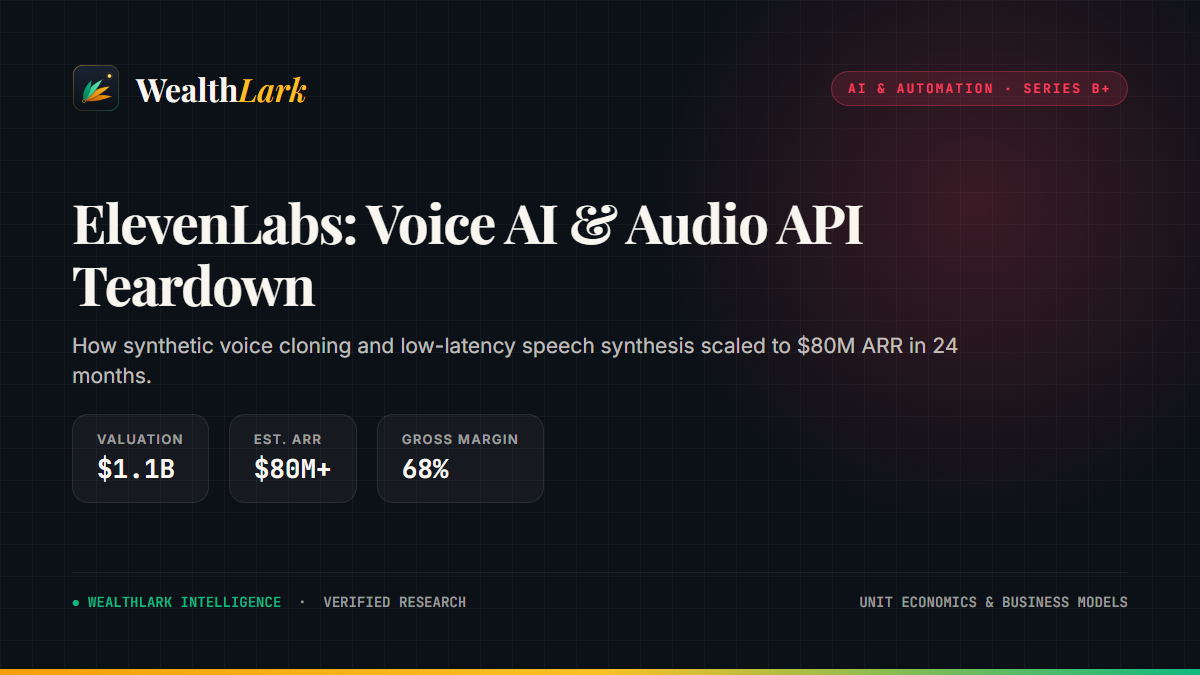
Valued at $1.1 billion following their Series B led by Andreessen Horowitz and Sequoia, ElevenLabs crossed $80 million in ARR by serving game studios, audiobook publishers, video game developers, global streaming dubbing networks, and conversational AI agent creators.
1. The Core Problem and Market Gap
Voice acting, audio localization, and corporate narration were historically among the most expensive bottlenecks in media production.
The Breakdown of Legacy Audio Production
- Expensive Studio and Talent Costs: Hiring professional voice talent costs $250 to $1,000 per hour, plus studio rental fees, sound engineering mastering, and multi-week revision scheduling.
- The Audio Dubbing Language Divide: Localizing a movie, video game, or YouTube video into 20 languages required hiring 20 separate voice actors, each with different vocal textures that diluted the original actor’s emotional delivery.
- The Uncanny Valley of Legacy TTS: Early algorithmic TTS sounded visibly unnatural. Voice inflections failed on questions, irony, or narrative suspense, making them unusable for entertainment, video production, or customer-facing conversational agents.
ElevenLabs solved this through contextual speech modeling: their neural architecture reads entire paragraphs before synthesizing, enabling the model to inject emotional resonance, excitement, or hesitation based on narrative meaning.
2. How They Make Money (Unit Economics Breakdown)
ElevenLabs pairs a transparent character-metered SaaS subscription model with custom high-ACV enterprise API licenses.
Subscription and Pricing Tiers
- Free Plan ($0/mo): 10,000 characters per month with standard voices. Drives top-of-funnel viral social clips.
- Starter Plan ($5/mo): 30,000 characters per month and instant voice cloning from a 1-minute audio sample.
- Creator Plan ($22/mo or $11/mo promo): 100,000 characters per month, professional voice cloning, and commercial rights.
- Pro Plan ($99/mo): 500,000 characters per month, higher audio bitrates, and API priority queuing.
- Scale Plan ($330/mo): 2,000,000 characters per month with ultra-low latency streaming access.
- Enterprise Custom ($2,500+/mo): Dedicated GPU capacity, custom voice model fine-tuning, automated video dubbing pipelines, and real-time conversational WebRTC endpoints.
Unit Economics Model (Estimated Per Average Creator Subscriber)
| Economic Metric | Cloud Vendor TTS Legacy | ElevenLabs Platform Actuals (2027) |
|---|---|---|
| Average Monthly Plan Price | $22.00 | $22.00 |
| Average Character Consumption | 82,000 Characters | 82,000 Characters |
| GPU Inference Cost (Nvidia H100 Clusters) | ($3.10) | ($5.80) (Higher Model Complexity) |
| Storage, Bandwidth, and CDN OpEx | ($0.60) | ($0.45) |
| Payment Processing (Stripe) | ($0.94) | ($0.94) |
| Net Gross Profit per Subscriber | $17.36 | $14.81 |
| Gross Margin (%) | 78.9% | 67.3% to 70.1% |
| Monthly Churn Rate | 6.8% | 3.2% (High Workflow Integration) |
3. Growth Drivers and Distribution Strategy
1. The Voice Library Creator Payout Marketplace
ElevenLabs launched the Voice Library: professional voice actors can record their voice, upload it to the platform, and earn passive royalties whenever other creators use their cloned voice model for videos or audiobooks. This transformed potential detractors (voice actors worried about AI replacement) into incentivized platform advocates.
2. The YouTube and TikTok Content Creator Flywheel
Millions of faceless YouTube automation channels, TikTok creators, and documentary narrators adopted ElevenLabs voices (like the famous “Adam” voice). When viewers heard compelling, cinema-grade narration, they asked “What voice is this?” in the comment section, creating continuous organic word-of-mouth discovery.
3. Ultra-Low Latency Conversational Agent Infrastructure
In 2024 and 2025, ElevenLabs released its low-latency Conversational AI SDK, reducing audio synthesis latency to under 150 milliseconds. This positioned ElevenLabs as the default voice layer for autonomous phone receptionists, customer service bots, and AI companions.
4. 3 Actionable Lessons for Entrepreneurs and Investors
Lesson 1: Benchmark Against Human Quality, Not Competing Software
ElevenLabs did not succeed because it was 10% cheaper than Amazon Polly; it succeeded because listeners could not tell the difference between its synthetic voices and a living human being in a recording booth. Reaching true human parity unlocks entirely new consumer use cases.
Lesson 2: Two-Sided Marketplaces Neutralize Industry Pushback
By letting voice talent monetize their clones, ElevenLabs built the largest curated library of diverse accents, languages, and dialects in the world while providing creatives with a recurring revenue stream.
Lesson 3: Latency is the Core Currency of Real-Time AI
Having great audio quality is useless for customer support agents if the customer must wait 2 seconds after speaking for the model to reply. Engineering a 150ms round-trip latency created an insurmountable technical moat in the enterprise contact center market.
Related Financial Terminals and Tools
- AI vs Rep Payroll ROI Calculator: Benchmark automated voice agent operational costs against traditional contact center staff.
- Solo-Founder AI Margin Modeler: Model lean media and software agency economics.
- SaaS Shadow-Tax Audit Teardown: Comprehensive audit of AI infrastructure and token billing.