

Executive Teardown Summary
Deel, founded in 2019 by MIT graduates Alex Bouaziz and Shuo Wang, capitalized on the greatest structural shift in modern labor economics: the transition to global, borderless remote work. While legacy payroll software (ADP, Paychex) was rigidly tied to domestic tax jurisdictions, Deel established legal entities in over 100 countries, allowing companies to legally hire, pay, and administer benefits to international workers in under 5 minutes.
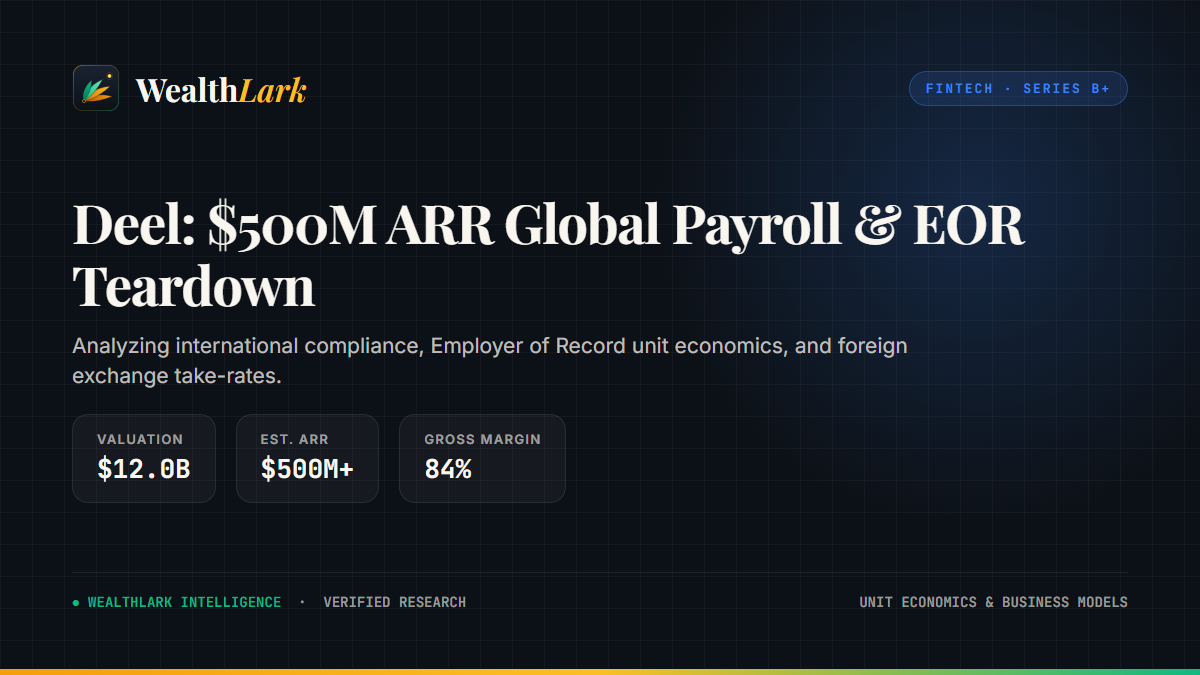
With over 35,000 corporate clients (including Shopify, Nike, and Reddit), Deel surpassed $500 million in Annual Recurring Revenue (ARR) while maintaining profitability and an 84% gross margin.
1. The Core Problem and Market Gap
Before Deel, hiring an international full-time employee or overseas contractor was a bureaucratic quagmire that required months of legal consultations.
The Breakdown of International Employment
- The Foreign Entity Incorporation Nightmare: If a US startup wanted to hire a senior software engineer in Germany or Brazil, they had to incorporate a local foreign subsidiary, hire local accountants, open local bank accounts, and register with statutory tax authorities—a process costing $30,000+ and taking up to 9 months.
- Permanent Establishment (PE) and Misclassification Risk: Treating an international worker as a casual 1099 contractor when they function as a full-time employee exposes corporations to crippling retroactive labor fines, payroll tax penalties, and intellectual property (IP) assignment disputes.
- Cross-Border Banking Wire Chaos: Sending wire transfers internationally meant dealing with volatile foreign exchange markups, lost SWIFT transfers, and high intermediary bank fees.
Deel solved this through its proprietary Employer of Record (EOR) infrastructure: Deel legally employs the worker through its own vetted local entity, while the client directs their day-to-day work, fully indemnifying the client against misclassification liability.
2. How They Make Money (Unit Economics Breakdown)
Deel built an exceptionally resilient, multi-tiered monetization structure that combines recurring software seat fees with lucrative fintech treasury spreads.
Revenue Breakdown
- Deel Contractor ($49/contractor/mo): Digital contract generation, automated W-8BEN compliance, local tax collection, and multi-currency withdrawal options.
- Deel EOR ($599/employee/mo): Full legal employment, statutory benefits administration, pension management, and localized employment contract indemnification.
- Deel US Payroll ($29/employee/mo): Domestic US multi-state payroll processing directly competing against Gusto and Rippling.
- Foreign Exchange and Treasury Spreads (0.5% to 1.5% FX Spread): Deel holds millions in client payroll float and earns interest income plus basis points when converting USD payroll into 120+ local currencies.
- Deel Card and Advance Fees (1% to 2% Fee): Immediate paycheck advances and debit interchange on the Deel Prepaid Mastercard.
Unit Economics Model (Standard High-Growth Tech Client with 30 Contractors and 8 EOR Workers)
| Revenue / Cost Stream | Monthly Volume | Deel Captured Revenue |
|---|---|---|
| 30 International Contractors ($49/mo) | 30 Contractors | $1,470 / Month |
| 8 Full-Time EOR Employees ($599/mo) | 8 Employees | $4,792 / Month |
| Cross-Border Payroll FX Spread (0.85% on $180k) | $180,000 Monthly Volume | $1,530 / Month |
| Total Monthly Revenue per Client | — | $7,792 / Month ($93,504/yr) |
| Direct Compliance, Legal, and Entity OpEx | — | ($1,240) |
| Deel Net Gross Profit per Client | — | $6,552 / Month |
| Deel Gross Margin (%) | — | 84.1% |
| Customer Retention (Net Revenue Retention) | — | 128% (Clients expand headcount) |
3. Growth Drivers and Distribution Strategy
1. The Global Entity Land Grab
While competitors acted as middlemen by reselling third-party local payroll agencies, Deel invested over $100 million in directly acquiring and establishing its own wholly owned legal entities worldwide. Owning the underlying legal rails allowed Deel to cut out middleman markups, resulting in an 84% gross margin versus competitors’ 50%.
2. The Recipient-Led Viral Loop
When an overseas contractor gets paid through Deel, they invite other clients to pay them via Deel to consolidate their contracts and tax documents in one dashboard. Every worker on Deel acts as a free inbound sales representative to other employers.
3. Aggressive M and A for Instant Geographic Scale
Rather than waiting years to build payroll infrastructure organically in complex markets, Deel acquired leading regional players: PayGroup (Asia-Pacific), Zeitgold (European compliance), and Zavvy (AI enablement and performance management).
4. 3 Actionable Lessons for Entrepreneurs and Investors
Lesson 1: Build the Hard, Unsexy Infrastructure First
Owning 100+ legal entities in countries with complex labor laws (like France or Brazil) is grueling, expensive, and legally demanding. But once built, it forms a nearly insurmountable competitive barrier that copycats cannot easily duplicate.
Lesson 2: Layer Fintech Spreads on Top of SaaS Subscriptions
SaaS revenue alone is great, but combining a $49/month software fee with a 1% spread on $180,000 of monthly transaction volume doubled Deel’s average revenue per user (ARPU) with zero incremental customer acquisition cost.
Lesson 3: Speed of Global Execution Trumps Local Perfection
Deel moved at breakneck velocity, launching in 30 countries in the time it took legacy competitors to evaluate a single foreign market. In hyper-growth categories, distribution velocity creates its own defense.
Related Financial Terminals and Hubs
- AI vs Rep Payroll ROI Calculator: Calculate fully loaded labor costs and global contractor tax burdens.
- US Personal Finance and Tax Hub: FICA wage limits, Schedule C rules, and contractor tax withholding.
- UK Personal Finance and Tax Hub: Employer National Insurance contributions and statutory employment rules.