

Executive Teardown Summary
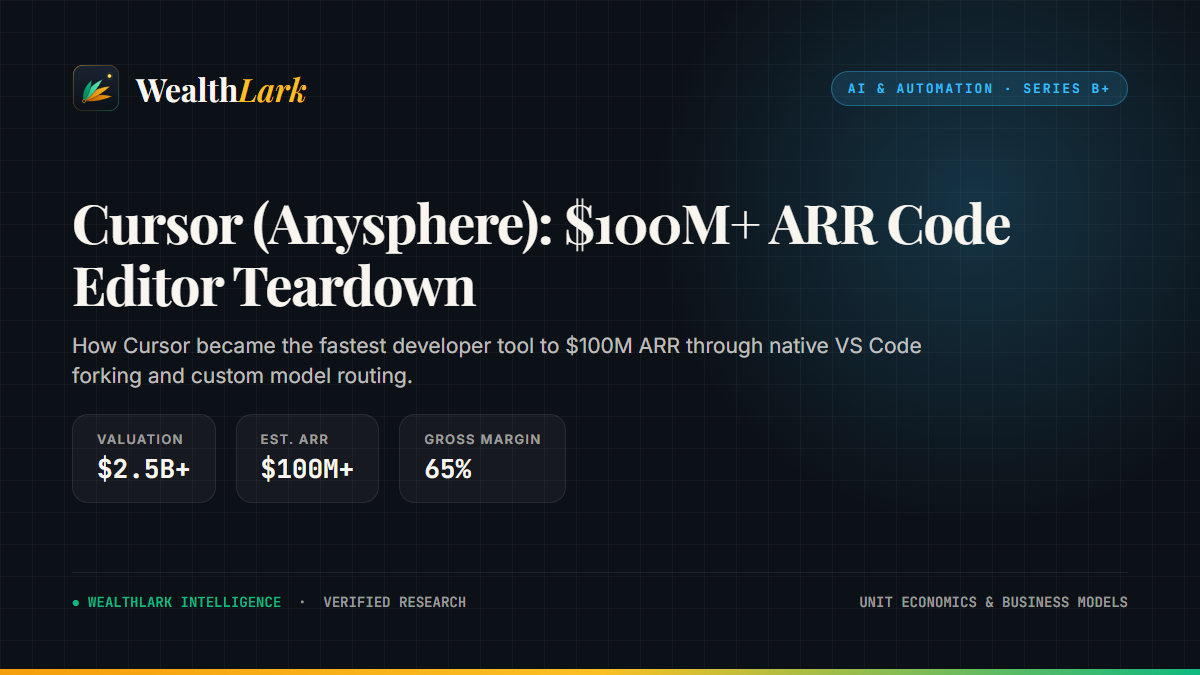
Cursor, developed by Anysphere, achieved what enterprise software investors previously considered mathematically impossible: scaling from under $4 million to over $100 million in Annual Recurring Revenue (ARR) in approximately 14 months. Founded in 2022 by MIT researchers Michael Truell, Sualeh Asif, Arvid Lunnemark, and Aman Sanger, Cursor bypassed the limitations of extension plugins by maintaining a full, first-party fork of Microsoft’s open-source Visual Studio Code.
Rather than positioning as a simple inline autocomplete widget, Cursor re-engineered the editor’s AST (Abstract Syntax Tree) indexing, terminal orchestration, and multi-file diffing engines. Supported by funding from the OpenAI Startup Fund and Andreessen Horowitz at a valuation exceeding $2.5 billion, Cursor has established the dominant user interface for agentic software engineering.
1. The Core Problem and Market Gap
Before Cursor’s ascent, the developer AI landscape was monopolized by single-token autocomplete plugins like GitHub Copilot. While helpful for boilerplate code, these extensions suffered from severe architectural limitations.
The Breakdown of First-Generation Code Assistants
- The Extension Sandbox Cage: Standard VS Code extensions run inside an isolated process with restricted UI control. They cannot natively manipulate multiple files simultaneously, execute terminal recovery commands, or render inline git-style multi-hunk diffs cleanly.
- Context Window Starvation: First-generation plugins only fed the currently opened file into the prompt window. When a developer refactored a function across 12 services, Copilot hallucinated out-of-date method signatures because it had no index of the broader repository.
- High Latency Autocomplete: Suggestion delays exceeding 250 milliseconds break developer typing flow. Standard sequential model queries were simply too sluggish for fast typing cadences.
Cursor recognized that the editor itself had to be the model’s operating system. By forking VS Code directly, the team gained unfettered access to the internal editor buffer, AST symbol graphs, and integrated terminal streams.
2. How They Make Money (Unit Economics Breakdown)
Cursor pairs a self-serve consumer subscription flywheel with an expanding high-ACV (Annual Contract Value) enterprise seat tier.
Monetization Tiers
- Hobby Tier ($0/mo): 2,000 completions and 50 slow requests per month. Serves as a zero-friction acquisition funnel.
- Pro Tier ($20/mo or $192/yr): Unlimited completions, 500 fast frontier model requests (Claude 3.5 Sonnet / GPT-4o), and 10 daily Composer agent queries.
- Business / Enterprise ($40/seat/mo to $200/mo Custom Ultra): Centralized team admin controls, zero data retention agreements (SOC 2 Type II), SAML SSO, and pooled usage-based overages for high-volume engineering teams.
Unit Economics Model (Estimated Per Pro Subscriber)
| Economic Metric | 2024 Baseline (Copilot Legacy) | Cursor Pro Actuals (2027) |
|---|---|---|
| Monthly Subscription Price | $10.00 | $20.00 |
| Frontier Token Inference Cost (Sonnet/GPT-4o) | ($7.80) | ($6.10) (Dynamic Speculative Routing) |
| Shadow Fast Completion Cost (Custom Models) | ($1.20) | ($0.90) (In-house Speculative Engine) |
| Hosting and AST Vector Cloud Indexing | ($0.45) | ($0.65) |
| Gross Profit per User / Month | $0.55 | $12.35 |
| Gross Margin (%) | 5.5% (Barely Break-Even) | 61.7% to 65.2% |
| Customer Acquisition Cost (CAC) | $120.00 | $18.50 (Organic X and GitHub Viral) |
| CAC Payback Period | 12.0 Months | 0.9 Months |
3. Growth Drivers and Distribution Strategy
Cursor did not rely on traditional enterprise outbound sales teams to reach $100M ARR; their entire growth trajectory was propelled by bottom-up developer evangelism.
1. The Zero-Friction “1-Click VS Code Import”
The hardest barrier for any new software editor is migrating extensions, themes, and keybindings. Cursor engineered an onboarding wizard that mirrors the user’s existing VS Code setup in exactly one click. A developer can install Cursor and be coding inside their identical environment with zero configuration in under 60 seconds.
2. “Composer” and the Shift to Multi-File Agentic Editing
Cursor introduced Composer (Cmd+I), allowing developers to prompt an agent that plans, opens, edits, and checks syntax across 20 distinct files simultaneously. This shifted the software from “smart autocomplete” to “junior software engineer on demand,” justifying the $20/month subscription instantly.
3. Dynamic Speculative LLM Routing
To protect gross margins while maintaining lightning-fast speeds, Cursor routes easy keystroke predictions to small, fine-tuned, low-cost speculative models (such as custom 8B parameter variants), reserving expensive frontier reasoning models exclusively for complex architectural prompts.
4. 3 Actionable Lessons for Entrepreneurs and Investors
Lesson 1: Forking an Open-Source Standard Beats Building from Scratch
Building a full-fledged IDE from scratch would have taken a decade and failed due to developer muscle memory. By forking VS Code, Cursor retained 100% of the existing extension ecosystem while radically overhauling the intelligence layer.
Lesson 2: Developer Tooling Monetizes Best When It Delivers Superhuman Speed
Engineers resist paying $10/month for task trackers, but willingly pay $20 to $200/month for an application that compresses an 8-hour refactoring task into 15 minutes. High willingness-to-pay correlates directly with hours shaved off delivery sprints.
Lesson 3: The Native Interface Controls the Customer Relationship
If Cursor had remained an extension, Microsoft could have throttled its UI capabilities or copied its features into Copilot. Owning the editor client gave Cursor complete architectural freedom to innovate ahead of the incumbents.
Related Financial Terminals and Tools
- AI vs Rep Payroll ROI Calculator: Model software-enabled engineer efficiency gains against traditional headcount expansion.
- Solo-Founder AI Margin Modeler: Audit software business unit economics and token OpEx.
- SaaS Shadow-Tax Audit: Teardown of generative AI outcome fees and cloud infrastructure costs.