
Sci-Fi Directors: Scott, Villeneuve and Miyazaki
How world cinema's greatest visual architects construct believable futures, command brutalist scale, balance hand-drawn mythology against digital volumes, and preserve tactile physical reality in an era of weightless synthetic spectacle.

Ridley Scott: Tactile Dystopias and Biomechanical Terror
Alien (1979) · Blade Runner (1982) · The Martian (2015) · $4.4B Box Office
Before Ridley Scott directed Alien in 1979, science fiction cinema had largely adhered to the pristine, antiseptic aesthetic popularized by Kubrick's 2001: A Space Odyssey. Scott revolutionized the genre by introducing the concept of the used future: spaceships coated in industrial grime, leaking hydraulic oil, and inhabited not by heroic adventurers, but by weary blue-collar freight haulers arguing over bonus shares.
Three years later with Blade Runner (1982), Scott established the visual vocabulary of cyberpunk. By combining 1940s film noir venetian blinds and trench coats with towering smoking industrial smokestacks, neon corporate monoliths, and persistent acid rain, Scott created a world so dense that every frame felt layered with decades of architectural sediment. Scott achieved this through practical miniature photography, multi-pass optical in-camera compositing, and real physical atmospheric smoke rather than digital shortcuts.

Denis Villeneuve: Brutalism, Sound Physics, and Desert Immersion
Arrival (2016) · Blade Runner 2049 (2017) · Dune: Part Two (2024)
Denis Villeneuve represents the modern zenith of intellectual, large-scale science fiction. While contemporary studio blockbusters leaned heavily on green screen soundstages and LED virtual volumes (such as StageCraft), Villeneuve insisted on physical locations for both Dune installments, shooting extensively in the Liwa Oasis of the United Arab Emirates and the Wadi Rum valley of Jordan.
Villeneuve's signature hallmark is brutalist architectural scale paired with clinical acoustic design. In Arrival (2016), the non-linear heptapod language was treated as a mathematical and phonetic puzzle, completely rejecting laser-gun tropes in favor of linguistic philosophy. For Dune: Part Two, Villeneuve collaborated with sound designers Mark Mangini and Richard King to construct the sound of the sand-walk and the seismic resonance of the Shai-Hulud sandworms using organic audio recorded from shifting dunes rather than synthetic library effects.
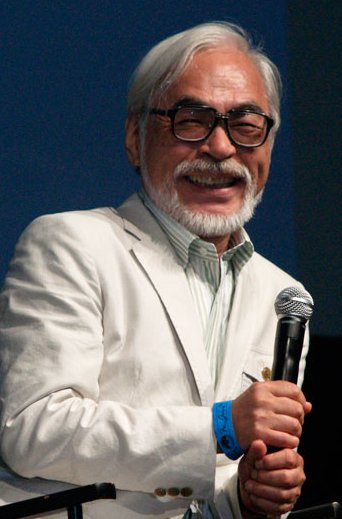
Hayao Miyazaki: Ecological Futures and Aerodynamic Soul
2x Academy Award Winner · Nausicaä · Princess Mononoke · The Boy and the Heron
Studio Ghibli founder Hayao Miyazaki approaches science fiction from a unique perspective: mythological ecology and human aeronautical obsession. In Nausicaä of the Valley of the Wind (1984), Miyazaki conceived a post-apocalyptic Toxic Jungle where giant arthropods called Ohmu protect a purifying ecosystem beneath radioactive spore forests. His vision avoided nihilistic despair, framing technological hubris as an ecological rupture that could only be healed through spiritual empathy.
Miyazaki is famous for drawing the flight physics of his imaginary aircraft by hand, imbuing ornithopters, flying boats, and floating iron-works with tangible aerodynamic weight and mechanical personality. In an animation landscape overwhelmed by algorithmic 3D rendering, Miyazaki's commitment to watercolor backgrounds and hand-drawn celluloid timing ensures that every world possesses an unmistakable human pulse.
Worldbuilding Methodologies: Practical vs Digital Volumes
| Director | Primary Technological Stance | Acoustic & Environmental Philosophy | Iconic World Created |
|---|---|---|---|
| Ridley Scott | Industrial miniatures, practical smoke, multi-pass optical in-camera compositing | Bleak hydraulic hiss, dripping water, clanking industrial air vents | Los Angeles 2019 (Blade Runner), Nostromo (Alien) |
| Denis Villeneuve | On-location Jordan/Abu Dhabi deserts, full-scale brutalist sets, IMAX cameras | Infrasound bass, shifting dune acoustics, non-verbal heptapod grammar | Arrakis (Dune), Earth (Arrival), Brutalist LA 2049 |
| Hayao Miyazaki | 100% hand-drawn keyframe animation, watercolor painted vistas, hand aerodynamics | Joe Hisaishi orchestral poetry, whispering wind, insect chittering | Sea of Corruption (Nausicaä), Laputa (Castle in the Sky) |
| Christopher Nolan | Full-scale practical rigs, 70mm IMAX celluloid, Kip Thorne relativistic physics | Shepard tone illusions, Hans Zimmer pipe organ, explosive airlock decompression | Gargantua Black Hole (Interstellar), Subconscious Limbo (Inception) |